The problem: nobody has the full picture
Most fleets still track equipment defects the same way: Excel sheets on individual laptops and long WhatsApp threads between ship and office. A crack noticed in the engine room might live in one engineer's spreadsheet, get mentioned in a message thread, and never make it into any register the superintendent could see. Nobody has the full picture, and assembling a fleet status report means hours of chasing messages and reconciling spreadsheets that never quite agree.
On an LNG carrier that is not just an admin problem. Defects that go unreported, or sit unassigned because nobody is sure who owns them, become safety and compliance risks. What a fleet needs is one register the whole chain of command can trust.
What we built: one register the whole chain of command can trust
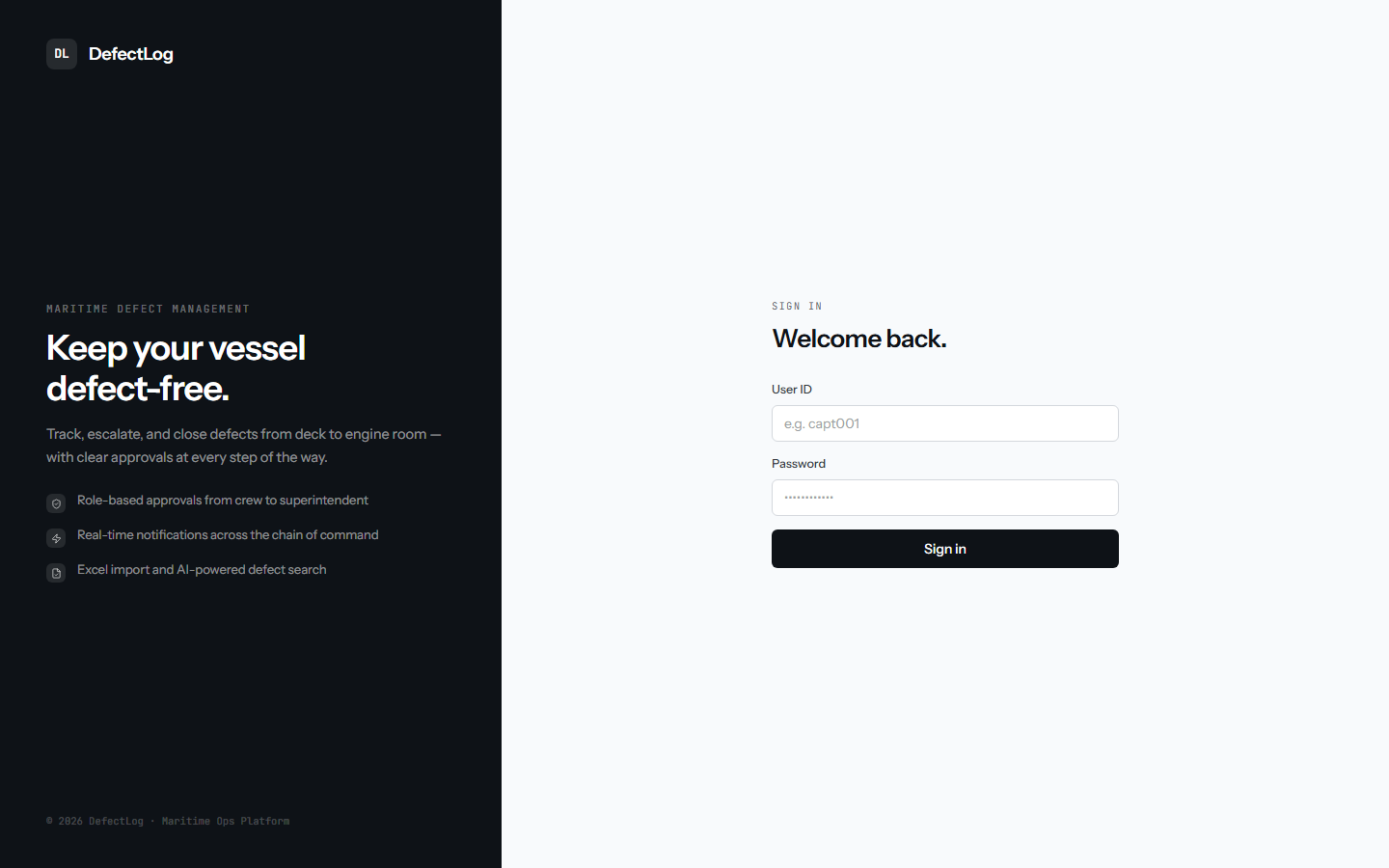
Working from the day-to-day reality of a shipping company operating LNG carriers, we built DefectLog: a purpose-built defect management platform for maritime operations. Crew log defects in seconds, superintendents review and approve them, and the office sees the state of every vessel in one dashboard. It runs in the browser and installs like a native app, so it works on whatever device is at hand on board. The platform is live, and we give walkthroughs of it on discovery calls.
How it works
- Voice-first logging. A crew member describes the defect out loud, and the form fills itself: title, description, location. They can also type, and attach photos of the damage. Logging a defect takes less time than sending the WhatsApp message it replaces.
- An approval chain that matches the ship's. Reports flow from crew to superintendent for review. Only approved defects enter the official register, so the register stays authoritative instead of becoming another noisy inbox.
- A fleet-wide defect register. Every approved defect in one filterable table: severity (critical, high, medium, low), status (open, in progress, closed), department, location, and who it is assigned to. Click any row and the full history and communications for that defect unfold in place.
- A fleet dashboard for the office. Active defects across the fleet, critical and high counts at a glance, vessels ranked by critical defects, and open defects broken down by severity. The hours-long status report is now a screen that is always current.
- Real-time notifications. When a defect is logged, approved, assigned, or closed, the right people know immediately, across the whole chain of command.
- Excel import and AI-powered search. Years of existing defect spreadsheets came along rather than being left behind, and anyone can find past defects by describing them in plain language.
- People and roles built in. Crew and officers are managed inside the platform, with ship and shore roles determining what each person can log, see, and approve.
What changes for a fleet
Defects stop living in private spreadsheets and message threads; they live in one register, with an owner, a severity, and a status that everyone from the engine room to the office reads the same way. Side by side:
| Excel + WhatsApp | DefectLog | |
|---|---|---|
| Fleet status report | Hours of chasing messages and reconciling versions | A screen that is always current |
| Logging a defect | A message that scrolls away under a birthday wish | A voice note that becomes a record, in seconds |
| Ownership | Nobody is sure whose job it is | Every defect has an owner, a severity, a status |
| History | Overwritten cells, yesterday's truth gone | Append-only history of every change, who and when |
| Visibility | One engineer's laptop | Deck to engine room to office, same picture |
DefectLog is live. We give walkthroughs of it on discovery calls.
See it liveWhat this shows we do
- Replacing spreadsheet-and-messaging chaos with one system of record.
- Designing around how people actually work: voice input for engineers with dirty hands, approvals that mirror the real chain of command.
- Practical use of AI where it earns its place: transcription that fills forms and search that speaks plain language, not AI for its own sake.
- Software that respects its environment, built to install and behave like an app on whatever hardware a vessel carries.
If your operation runs on spreadsheets and message threads that nobody fully trusts, this is the shape of the fix. Our custom software and workflow automation work exists for exactly this. The FAQ covers how we scope and price, and the other case studies show the same pattern in different sectors.